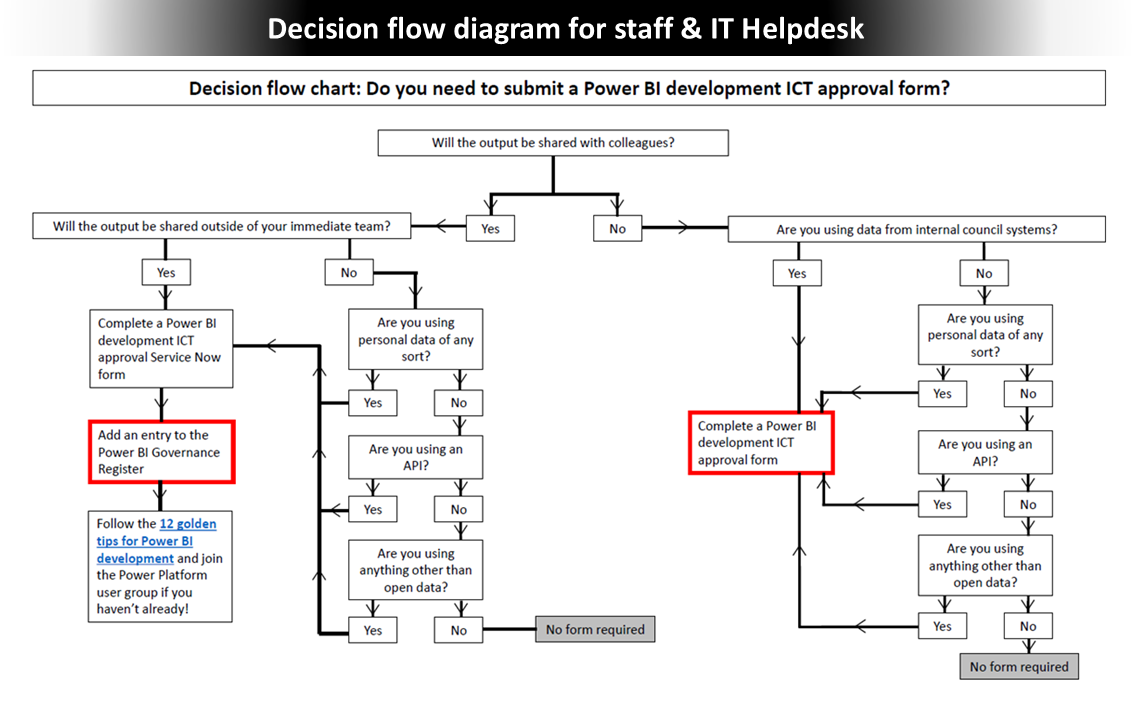
Slide 1: Decision Flow Diagram for Staff & IT Helpdesk
Situation: Staff in a local authority were encouraged to develop Power BI dashboards, but faced uncertainty about when IT approval was needed. This led to inconsistent submissions and data security risks. A clearer, simpler process was needed.
Actions: I created a decision flow diagram to guide staff on IT approval requirements, translating technical terms into plain language. This diagram defines submission criteria and aligns staff behaviour with data protection expectations.
Results: The process improved oversight of Power BI developments. Dashboards requiring review were consistently identified, reducing confusion and reinforcing compliance with data security and GDPR.
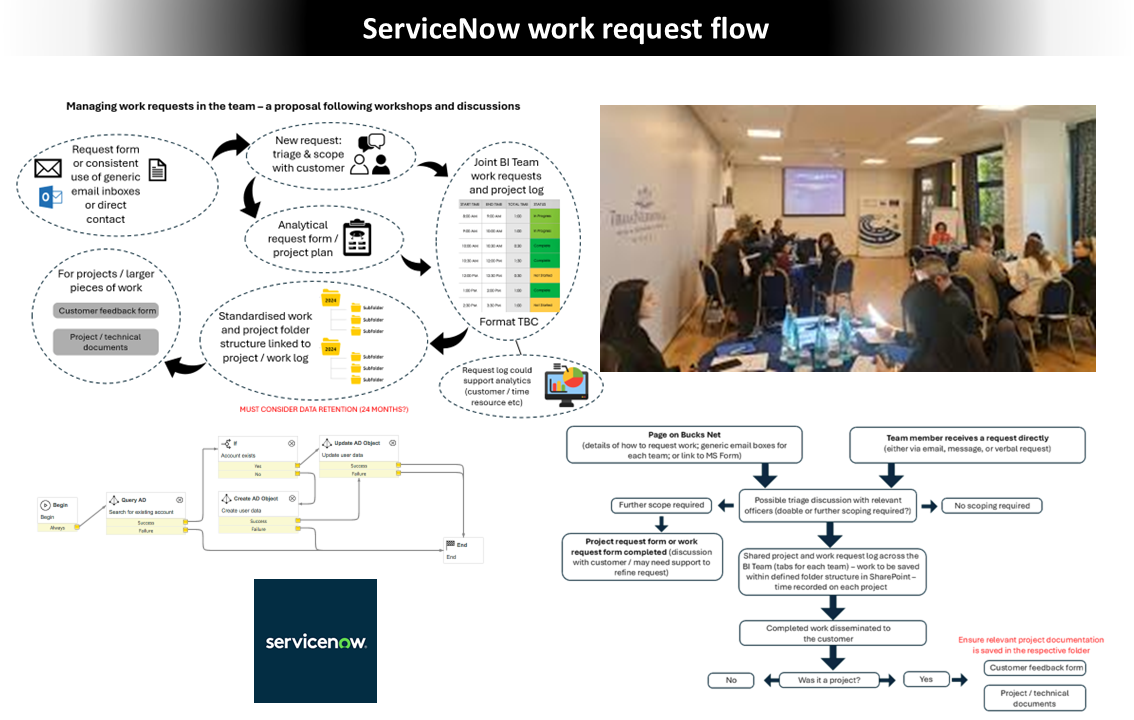
Slide 2: ServiceNow Work Request Flow
Situation: A Data and Analytics team needed to transition to ServiceNow for logging requests and support. Inconsistent methods for recording work led to poor visibility and duplicated efforts. A standardised process was essential for better coordination and governance.
Actions: I engaged the team to discuss the move to ServiceNow, forming a cross-team working group and conducting structured workshops. I mapped existing processes, identified pain points, and proposed a new request flow for approval from corporate management.
Results: The ServiceNow process established a single entry point for requests, improving tracking and prioritisation. Customers found it easier to submit requests, while the team benefited from clearer workloads and improved governance, leading to a more efficient service.
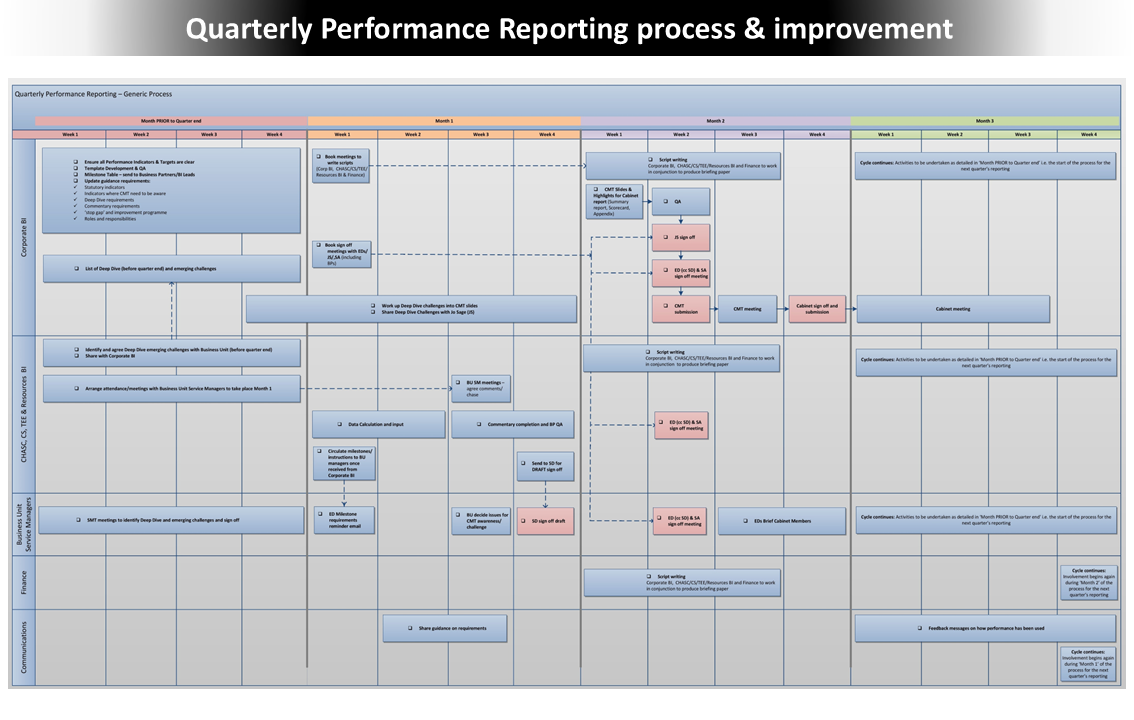
Slide 3: Quarterly Performance Reporting – Process Review & Recommendations
Situation: A local authority’s quarterly performance reporting was overly complex, involving 140+ KPIs and contributions from over 50 staff. The process was time-consuming and inconsistent, needing simplification.
Actions: I facilitated workshops for stakeholders to share their roles and frustrations, and analysed this input to produce detailed process mapping. I documented the current process, co-designed a future state model, and recommended fewer KPIs and new performance management software.
Results: Senior leaders endorsed the recommendations and approved a work program I managed to implement new software. The redesigned process improved transparency and accountability, making performance data easier to scrutinise and supporting better decision-making.
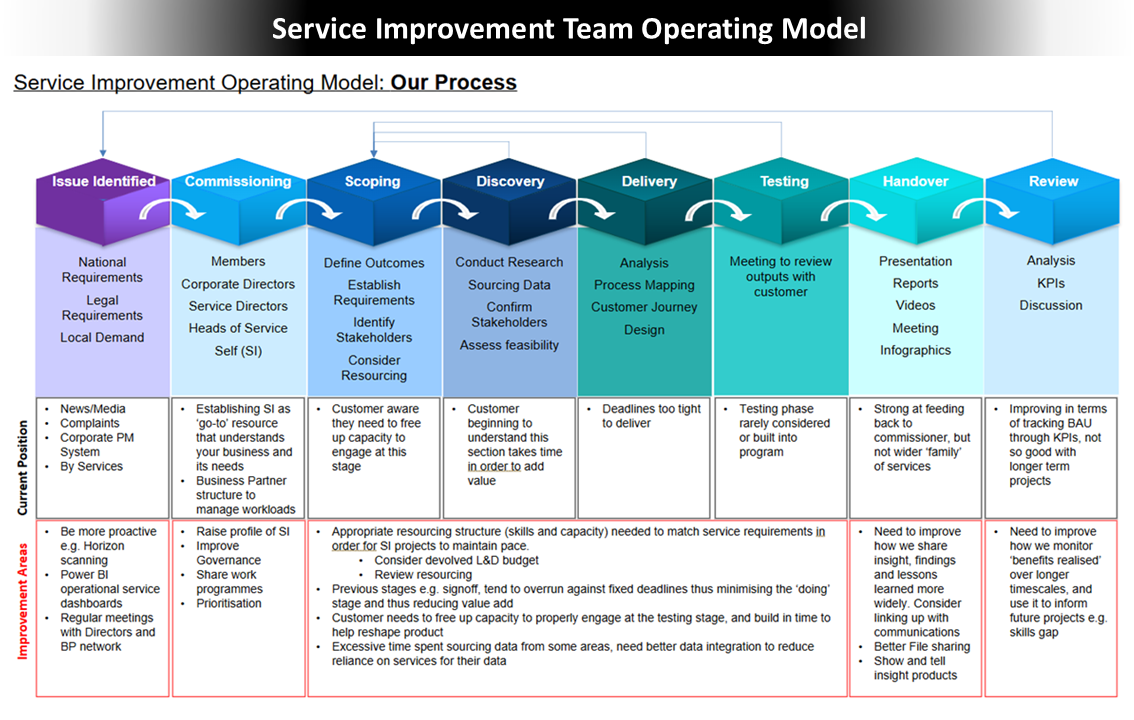
Slide 4: Service Improvement Team Operating Model
Situation: A service improvement team struggled to articulate their operations due to time constraints. Their primary tool was a complex 30-slide presentation, which confused stakeholders and hindered engagement.
Actions: I worked with the team to clarify their operations, simplifying the presentation while highlighting practical experience. I engaged stakeholders to gather feedback and ensure the new model addressed their needs.
Results: The revised operating model improved stakeholder understanding and engagement. The simplified approach facilitated clearer communication, leading to more productive interactions and a more effective transformation of their services.
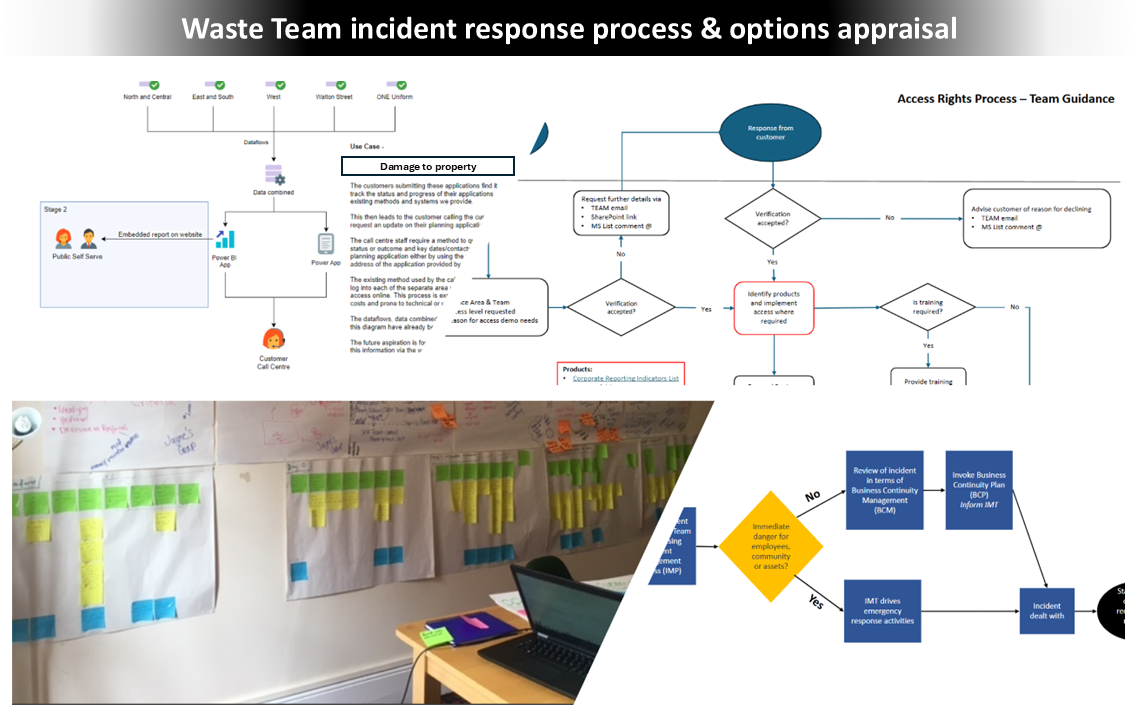
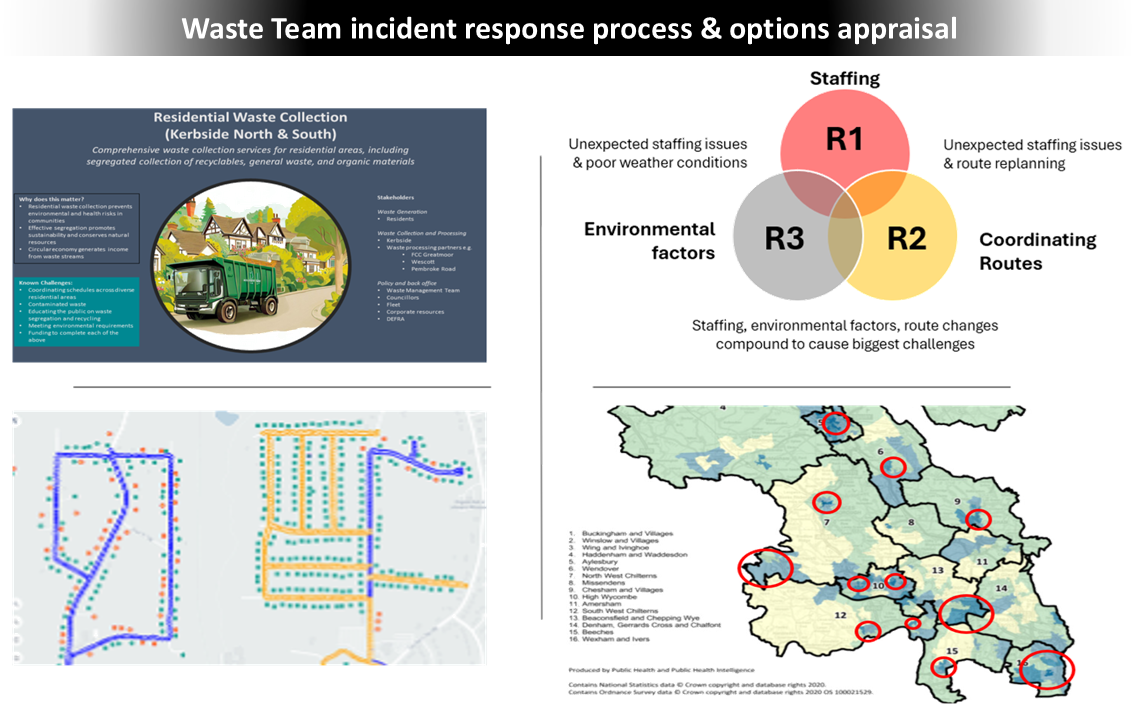
Slide 5 & 6: Waste Team Incident Response Process & Options Appraisal
Situation: A waste collection contractor needed to enhance its incident response after an audit revealed reliance on a few staff members, posing risks to continuity and operational resilience. The audit identified limited flexibility during incidents, causing delays and service disruptions, especially during staffing shortages and adverse weather.
Actions: I organised meetings and focus groups to document current processes. I identified four root causes of disruption: staff sickness, inadequate flexible working, poor coordination in weather incidents, and underused route-planning software. I presented an options appraisal to senior leaders from the contractor and local authority.
Results: The findings prompted interest in piloting flexible working and in implementing screen-recorded incident logging to improve training. Enhanced use of route-planning software was also recognised as a way to improve responsiveness.

